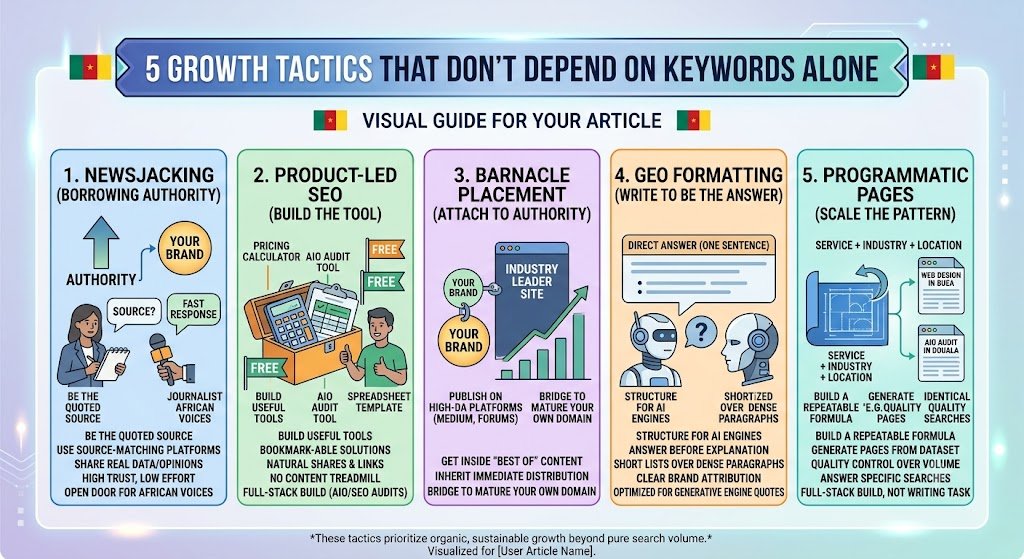
# 5 Growth Tactics That Don't Depend on Keywords Alone
Most businesses think SEO means picking keywords and writing blog posts until something ranks. That's one lever. It's not the only one, and for a new or growing brand, it's often not the fastest one.
Here are five approaches I use that work with search engines and AI engines at the same time — because in 2026, you're not just trying to rank. You're trying to get cited, quoted, and recommended by systems that read the whole web before they answer a question.
1. Newsjacking: borrow the authority you don't have yet
You don't need to buy backlinks. You need to be the source a journalist quotes.
- Monitor journalist requests on platforms built for source-matching.
- Respond fast with a real number, a real opinion, or data specific to your market — generic quotes get ignored.
- One quote in a national or industry publication earns more trust, in one link, than months of guest posting.
For a Cameroonian or African brand, this is underused. Local and international journalists covering tech, fintech, or business in Africa are often short on sourced voices from the ground. That's an open door.
2. Product-led SEO: build the tool, not the article
People don't bookmark blog posts. They bookmark things that solve a problem for them every week.
- Find the spreadsheet, template, or manual calculation your audience already does by hand.
- Turn it into a free, working tool on your site.
- The tool becomes the thing people link to, share, and return to — no ongoing content treadmill required.
This is exactly the kind of build I put under "Full-Stack Systems" in my own service stack. A free SEO/AIO audit tool or a pricing calculator does more for a brand's visibility than ten articles, because it's useful on its own, not just readable.
3. Barnacle placement: attach to authority instead of building it from zero
New domains take months to earn trust. Big platforms already have it.
- Publish long-form, genuinely useful content on platforms with existing authority — Medium, industry forums, Q&A platforms.
- Get featured inside existing "best of" or comparison content that already ranks.
- You inherit distribution immediately instead of waiting for your own domain to mature.
This isn't a replacement for your own site — it's a bridge while your own domain authority catches up.
4. GEO formatting: write to be the answer, not just the article
AI engines don't reward long, meandering posts. They reward content that's structured to be lifted whole.
- Put a direct, one-sentence answer near the top of the section, before the explanation.
- Use clear headers that match the way people actually ask questions.
- Use short lists over dense paragraphs wherever a list is honestly clearer.
- Name your brand and your specific claim clearly enough that an AI engine can attribute the answer to you.
This is the core of what I mean by AIO and GEO: the content isn't just optimized to rank — it's structured so a generative engine can quote it, cite it, and send someone straight to you.
5. Programmatic pages: scale the pattern, not the writing
Some searches repeat in a predictable shape — a service, an industry, a city. That pattern is buildable, not writable one page at a time.
- Identify the repeatable formula behind your niche's searches (service + industry + location, for example).
- Build a template and a dataset, and generate the pages from it.
- Quality control matters more here than volume — a thousand thin pages will hurt you. A few hundred genuinely useful ones, each answering a real, specific search, will not.
This is a full-stack build, not a content task — which is why it tends to get skipped by agencies that only do writing.
---
None of these five replace solid technical SEO or good writing. They're what you add once the foundation is in place, so growth doesn't depend on outranking everyone for the same ten keywords.
Want this built into your growth system instead of just read about it?
Start a Project