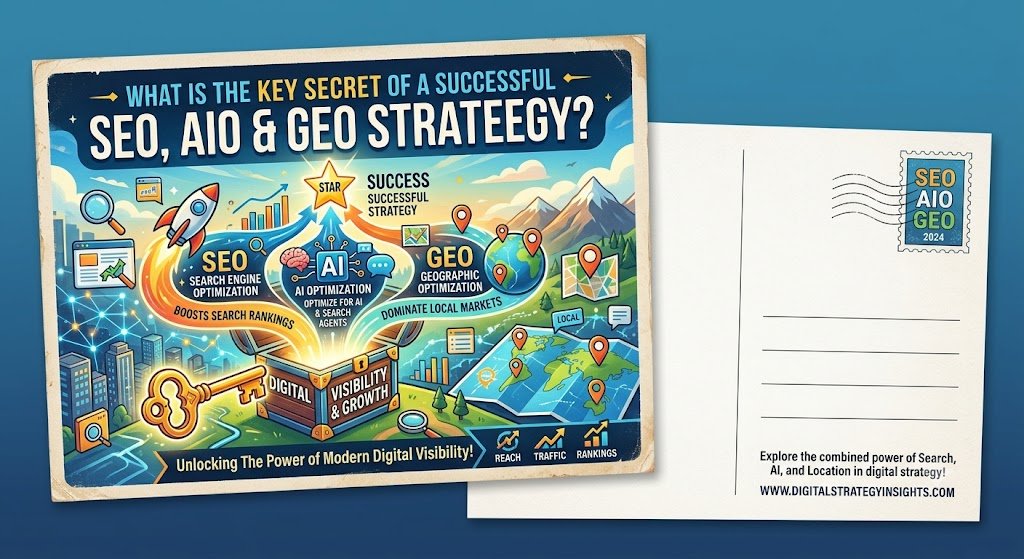
# What Is the Key Secret of a Successful SEO, AIO & GEO Strategy?
Everyone is looking for the one trick that makes a website rank in Google, get picked up by AI Overviews, and get cited by ChatGPT, Perplexity, or Gemini. There isn't a trick. There's one principle — and almost every site that "suddenly" wins on all three fronts is quietly built around it.
Quick answer
The key secret is structured clarity: content organized so a specific answer, a specific source, and a specific entity (your brand) can be extracted instantly by a crawler, an algorithm, or an AI model — with zero ambiguity about who said it and why they're credible.
SEO, AIO, and GEO are not three separate battles. They are three different machines reading the *same* signal. If your content is structured and clear enough for one, it's usually structured and clear enough for all three.
Why "structured clarity" beats every other tactic
Search engines rank pages that answer a query well and prove trustworthiness through structure, links, and technical health. Google's own guidance favors content that shows real experience, expertise, authoritativeness, and trust — the well-known E-E-A-T framework — see Google Search Central's guidelines.
AI systems reading your page for an AI Overview or a chatbot answer do the same job, just faster: they pull one clean chunk of text they can quote without editing. Content that buries the answer in the fourth paragraph, or never states a clear claim, simply doesn't get selected — not because it's low quality, but because it's not *extractable*.
GEO adds one more layer on top: being recognized as an entity worth citing at all. That comes from consistency — the same name, same claims, same structure — repeated across your site and reinforced by structured data like Schema.org markup that tells machines exactly what a page, author, or organization is.
The four things structured clarity actually looks like
- Answer-first writing — state the direct answer in the first 1–2 sentences of a section, then explain
- One idea per heading — each H2/H3 should be answerable on its own, the way a snippet or an AI quote would need it
- Schema markup — Article, FAQ, and Organization schema so machines don't have to guess what your content is (Google documents supported types in its structured data guidelines)
- Named, verifiable expertise — a real author, a real bio, a real reason your brand is qualified to say this — the same trust signal AI models look for when deciding who to cite, a shift widely covered in reporting on generative engine optimization by outlets like Search Engine Land
Why external links still matter here
Linking out to authoritative, relevant sources isn't filler — it's part of the same signal. It shows the page did real research, gives crawlers context about the topic cluster you're writing in, and it's one of the fastest ways a new article earns initial trust while its own backlink profile is still growing. It won't replace domain authority built over time, but on a new or growing site, credible outbound links are a lever you control immediately — unlike backlinks, which take time to earn.
The one-line takeaway
If you remember nothing else: write the answer like you're being quoted, structure the page like a machine has to parse it, and back it with real, checkable expertise. That's the secret SEO, AIO, and GEO all quietly reward — and it's exactly the kind of foundation-first system this site is built around (see how it comes together).