# Sentiment Analysis for SEO: Tools, Trust Signals & Strategy Guide
Search used to be a ranking game. Now it's a reputation game.
Traditional SEO asked one question: *does this page match the query?* Today, with AI Overviews, ChatGPT, Perplexity, and answer engines pulling from the open web, the question has expanded: *does this brand deserve to be recommended?* That second question is answered less by keywords and more by sentiment — how people, reviews, forums, and press actually talk about you.
This is where sentiment analysis stops being a "nice to have" for social media teams and becomes core infrastructure for SEO, AIO (AI Optimization), and GEO (Generative Engine Optimization).
Why Sentiment Now Matters for Search
Classic SEO trust signals were mostly mechanical: backlinks, domain age, site speed, schema markup. Those still matter. But generative engines are trained to synthesize an answer, not just rank ten blue links — and synthesis leans heavily on consensus and tone.
A few consequences of that shift:
- AI answer engines cross-reference sentiment before citing a source. If review platforms, Reddit threads, and press coverage skew negative, an LLM is less likely to recommend that brand even if its own website is well-optimized.
- GEO rewards brands that are talked about positively across many independent sources, not just the ones that talk about themselves well. A polished homepage can't outweigh a pattern of poor reviews the way it might have outweighed weak backlinks in 2015.
- Trust signals are now distributed, not centralized. Google's E-E-A-T (Experience, Expertise, Authoritativeness, Trust) already pointed this direction; generative engines have accelerated it by pulling directly from review sites, forums, and social sentiment as part of their training and retrieval layers.
In short: sentiment analysis is how you measure the input that AI systems are already using to decide whether to mention you at all.
What Sentiment Analysis Actually Measures
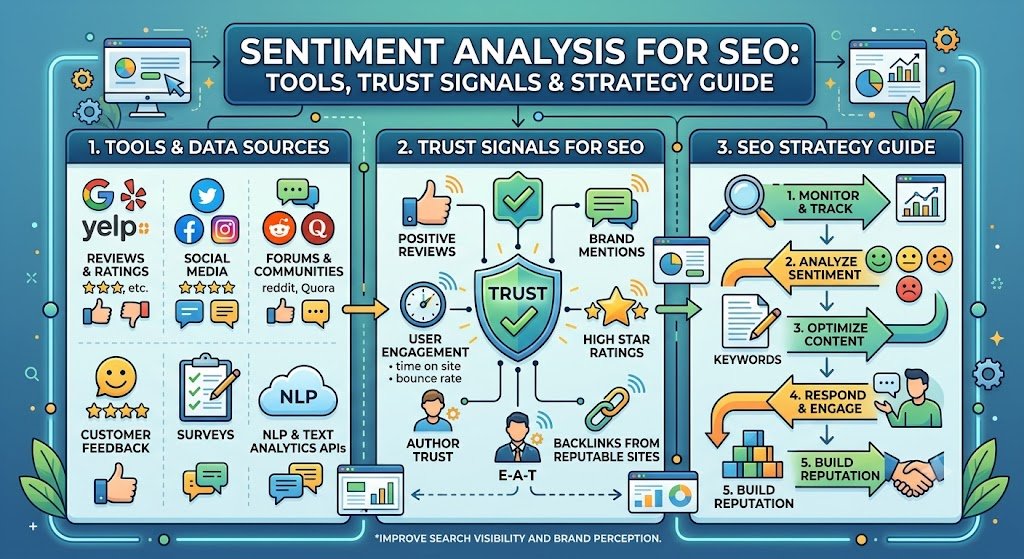
At its core, sentiment analysis is natural language processing that classifies text as positive, negative, or neutral — and increasingly, by emotion or intent (frustration, trust, urgency, satisfaction). For SEO/AIO/GEO purposes, the useful inputs are:
- Reviews (Google Business Profile, Trustpilot, G2, industry-specific platforms)
- Social mentions (X, Reddit, LinkedIn, niche forums)
- News and press coverage
- On-site feedback (comments, testimonials, support tickets)
- Comparison and "vs" content written by third parties
The goal isn't just a positive/negative score — it's understanding *which specific claims* about your brand keep recurring, because those recurring claims are exactly what an AI system will surface when someone asks about you.
Tools Worth Knowing
A practical toolkit, organized by what each one is actually good for:
Social & brand listening
- Brandwatch, Sprout Social, Mention — track volume and sentiment trend over time across social and web mentions.
Review monitoring
- Google Business Profile insights, Trustpilot, Birdeye — centralize review sentiment and flag emerging complaint patterns before they scale.
NLP / developer-level analysis
- Google Cloud Natural Language API, AWS Comprehend, Hugging Face sentiment models — useful if you want to build custom sentiment scoring into a dashboard or pipeline rather than rely on an off-the-shelf UI.
AI-visibility specific
- Tools now emerging in the GEO space (e.g. Profound, Otterly, AthenaHQ-style trackers) don't just measure sentiment in isolation — they show *what LLMs are actually saying about your brand* when prompted, which is the most direct signal of how your sentiment profile is translating into AI-generated answers.
You don't need all of these. A lean setup — one review monitor, one social listening tool, and periodic manual prompts to ChatGPT/Perplexity asking "what do people think of [brand]?" — covers most small and mid-size businesses.
Trust Signals That Compound
Sentiment analysis tells you where you stand. These are the signals worth actively building:
1. Third-party validation over self-promotion. A case study on your own site carries less weight than the same result mentioned unprompted in a forum thread or review.
2. Consistency across platforms. Conflicting claims about pricing, quality, or service between your site and external mentions erode trust — and confuse AI systems trying to synthesize a single answer.
3. Recency. Old negative reviews with no recent response read differently than the same issue addressed and resolved. AI systems tend to weight recent sentiment more heavily.
4. Response behavior. Publicly and professionally responding to negative reviews is itself a trust signal that both humans and AI-summarized content pick up on.
5. Structured proof. Testimonials and reviews marked up with `Review` and `AggregateRating` schema make sentiment machine-readable, not just human-readable — directly feeding both classic SEO and GEO.
A Practical Strategy Guide
Step 1 — Audit before you optimize.
Run your brand name through a sentiment tool and, separately, ask 2–3 AI answer engines directly what they say about you. The gap between the two often reveals what needs attention first.
Step 2 — Fix the loudest negative pattern.
Don't chase every complaint. Find the *one* recurring theme (slow support, unclear pricing, a specific product flaw) and resolve it publicly. One resolved pattern outweighs a dozen scattered five-star reviews.
Step 3 — Seed structured, third-party proof.
Encourage reviews on platforms AI engines actually pull from, and mark up testimonials with schema so the sentiment is explicit, not just implied.
Step 4 — Monitor AI-specific mentions, not just search rankings.
Add "ask ChatGPT/Perplexity about us" to your regular reporting cadence, alongside traditional rank tracking. This is the fastest-changing part of visibility right now.
Step 5 — Close the loop.
Feed what you learn back into content: FAQ pages, comparison pages, and support documentation that directly and honestly address the concerns sentiment analysis surfaced. This is content AI systems are increasingly likely to cite, because it resolves ambiguity rather than adding to it.
The Bigger Picture
SEO, AIO, and GEO aren't three separate disciplines anymore — they're three lenses on the same underlying question: *is this brand trustworthy enough to recommend?* Sentiment analysis is the measurement layer that ties them together. Technical SEO gets you found. Sentiment and trust signals get you recommended — by people and by the AI systems increasingly standing between your brand and your next customer.